
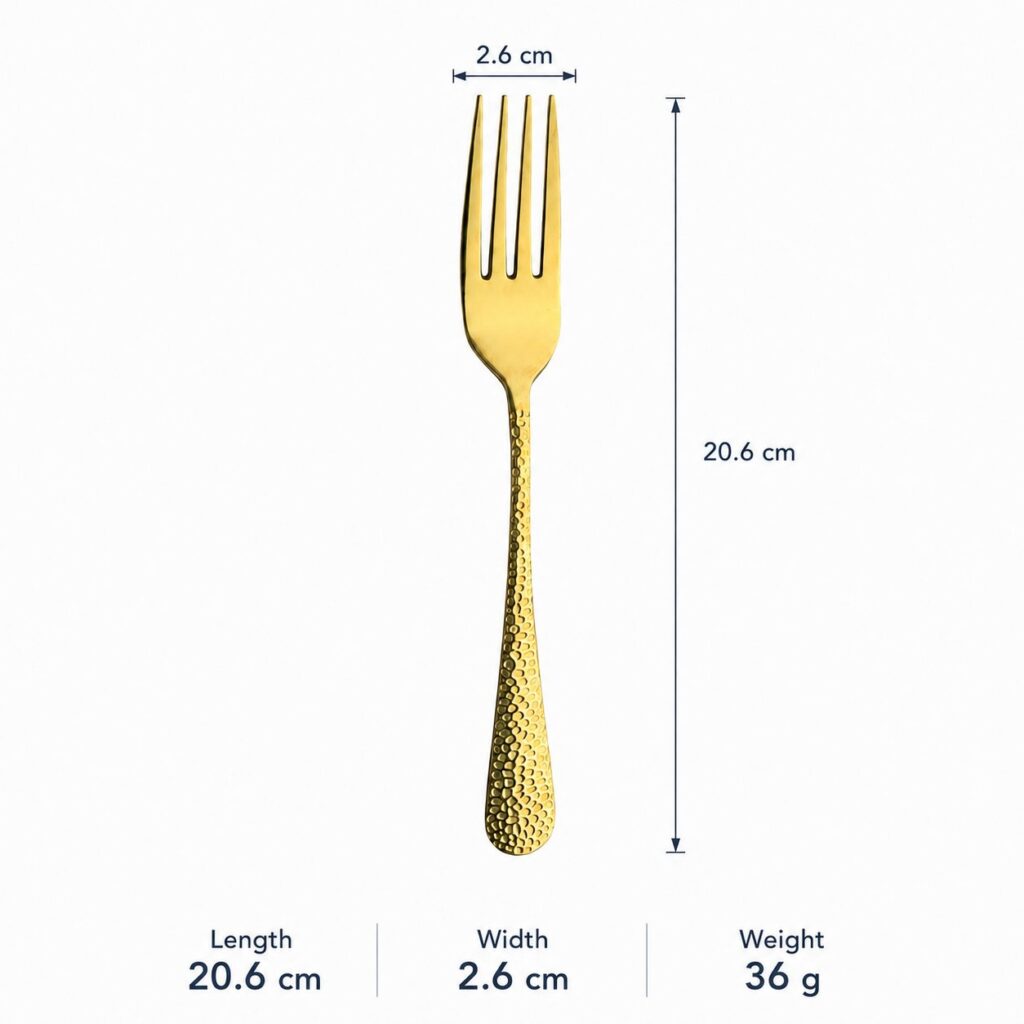
A cutlery RFQ should identify every member included in one quoted set and state the quantity of each. Ask the supplier to confirm whether its quotation unit is an individual utensil, a complete set or another defined pack. Chengda Kitchen’s gold hammered cutlery listing and individual gallery references help identify the enquiry; a collection of product pictures does not by itself confirm the contents of an order.
Start with the actual cutlery reference
Buyers comparing wholesale cutlery and flatware need a shared definition of the offer before comparing quantities. Attach the actual product URL and ask the supplier to identify the version being quoted. Keep the visible gold-coloured appearance and patterned handle reference attached to that enquiry rather than treating a general category name as a complete specification.
Chengda’s product description includes individual knife, fork and spoon references. These are useful identification aids. They do not establish which combination the supplier will include, how many of each member will be supplied or whether the pictured selection is sold as one fixed set. Ask for those points in the written reply instead of counting objects in a promotional arrangement.
Give every requested member a separate row
Create one row for each utensil requested. Use a short reference such as the named catalogue image alongside the buyer’s working description. Where the gallery contains different spoon sizes, keep them distinguishable until the supplier returns its own member names or identifiers. A general word such as spoon can otherwise hide a substitution between two different references.
Ask the supplier to mark each row included, excluded or proposed as an alternative. An unanswered row should stay pending. This prevents a single set total from appearing complete while its members remain unclear. The working schedule below requests answers; it does not assert that every illustrated member is part of an available combination.
Schedule row | Buyer reference | Supplier confirmation
Knife | Identified knife catalogue view | Member identifier and quantity per set
Fork | Identified fork catalogue view | Member identifier and quantity per set
Larger spoon | Separate illustrated spoon reference | Offered member name and quantity
Smaller spoon | Separate illustrated spoon reference | Included, excluded or alternative
Other component | Only if specifically requested or offered | Describe separately and state inclusion
Quotation unit | Piece, complete set or defined pack | Confirm the object priced and counted
Separate supplied pieces from appearance references
The knife, fork and spoon images accompanying this article carry supplier catalogue measurements. Use them to point to the intended member. Do not adopt their dimensions or mass as verified order specifications without a response tied to the offered version. If dimensions matter, ask for a separate confirmed specification or identified sample record.
A shared handle pattern also does not establish identical material, finish process or performance across every member. Those questions need their own supplier answer. This schedule concerns what is supplied and counted. It does not verify steel grade, hardness, coating composition, dishwasher suitability or another claim appearing elsewhere in the catalogue.
Make the quotation unit explicit
Ask which counted object the price and order quantity refer to. One amount may describe an individual utensil while another describes a complete set. Preserve the supplier’s original unit beside any buyer calculation. A comparison is meaningful only after the member schedule and the quotation unit refer to the same offered grouping.
Where the buyer requests several complete sets, retain the confirmed number of each member per set and the requested set quantity together. Calculate the corresponding member totals from those returned factors. Do not multiply by an assumed gallery count or invent a packing ratio. If the supplier proposes a different set composition, put it on a separate offer line before recalculating the totals.
Keep packing and extras visible
Ask whether any holder, gift box, sleeve or other accessory is included when such an item is proposed. Do not add one because it is common in the category or appears beside a related product. A packing component should have its own description and inclusion status rather than becoming an unnamed extra inside the utensil count.
Before accepting the quotation, check the completed schedule against the supplier’s final response. Keep the original request and proposed alternative distinguishable. If one member changes, ask whether the set identifier, quantity calculation or quotation needs a new revision. The useful output is a clearly defined supplied combination, not a broad approval of every catalogue picture.
• Identify every requested utensil by an unambiguous reference.
• Confirm the quantity of each member in one offered set.
• Keep accessories and packing components separate from utensil counts.
• Reconcile the quotation unit and all member totals before accepting the offer.
Send a piece-schedule enquiry
An RFQ can read: For the identified hammered-pattern cutlery reference, please return the members and quantities included in one offered set. Identify each knife, fork and spoon version, state the quotation unit and list any packing component or accessory separately. Please mark exclusions and alternatives clearly, and keep unanswered members pending. Send the schedule through Chengda Kitchen’s actual product and contact links.
Frequently asked questions
Does a set photograph confirm the sale contents?
It provides an appearance reference. Ask the supplier to confirm the actual members and quantities included in its written offer.
Should two spoon references share one row?
Keep them separate until the supplier identifies the exact members offered. Similar handle decoration does not make them interchangeable.
Can a buyer compare a piece price with a set price directly?
First confirm the supplied combination and quotation unit. Then use the supplier-confirmed factors for any comparison rather than an assumed picture count.
Product and contact references
https://chengdakitchen.com/product/410-high-hardness-stainless-steel-gold-hammered-cutlery-set/
https://chengdakitchen.com/products/?product_filter=cutlery-flatware
https://chengdakitchen.com/contact/
https://chengdakitchen.com/blog/