
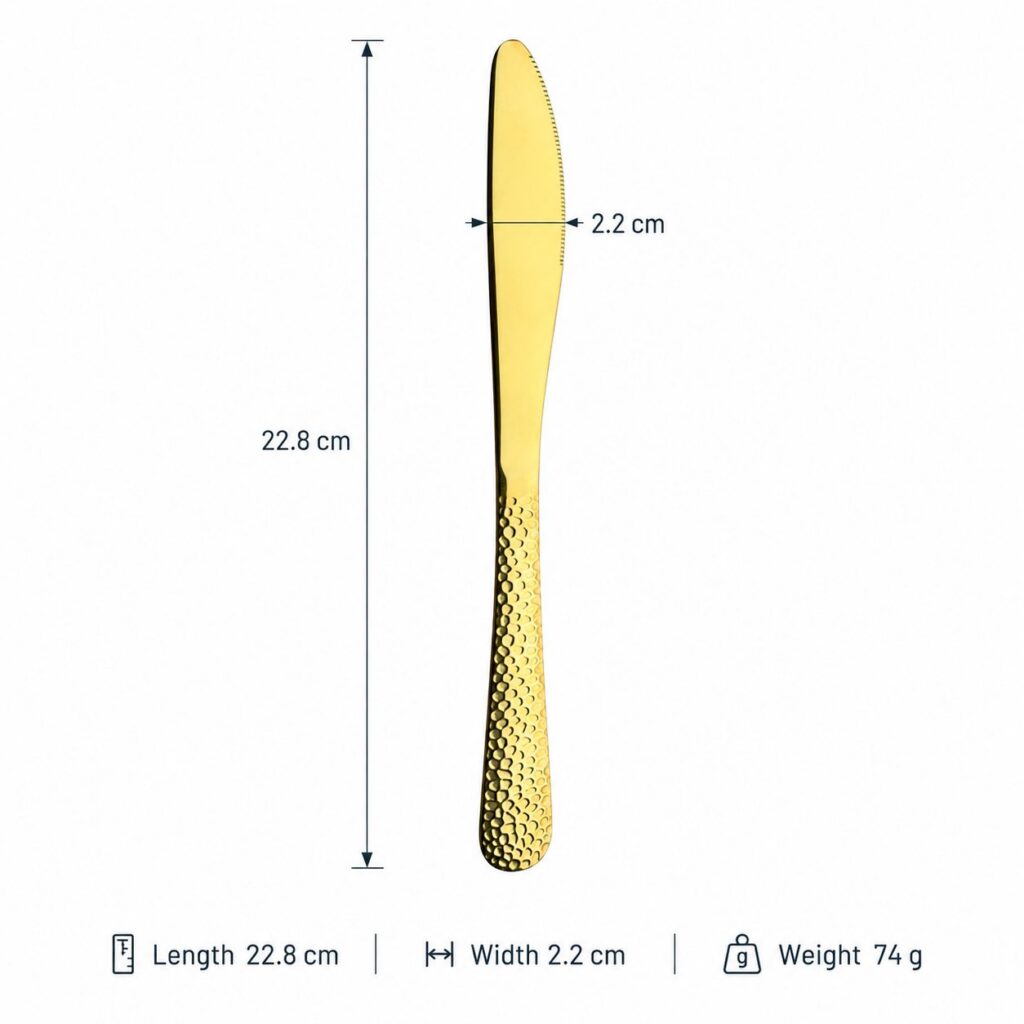
Ask the supplier to identify the proposed cutlery arrangement and mark the areas where each member touches another utensil or an offered packing component. Link the layout to an identified packing example and record what is observed when it is opened. Chengda Kitchen’s individual cutlery images help locate the knife, fork and spoon areas; they do not confirm the packing supplied or prove protection during shipment.
Start from identified members and an offered layout
A buyer sourcing wholesale cutlery and flatware needs to know more than whether a set fits inside a package. The packing record should show how the identified members are arranged and what is beside each relevant area. Begin with the actual product reference and the member schedule being quoted. Keep the packing decision separate from the earlier decision about which utensils are included.
Ask the supplier to describe the layout it proposes for that offer. If the buyer supplies a preferred arrangement, label it as a request until the supplier responds. The knife, fork and spoon catalogue photographs show the product references, not a commercial packing example. No gift box, sleeve, separator or individual wrapping should be assumed from those photographs.
Name every proposed packing component
List each component that the supplier actually proposes, alongside its stated purpose or position. A wrapper, separator or holder can be discussed as a requested option without being presented as already supplied. Ask whether it is included in the offer or requires a separate quotation. Do not choose a material or a protective function on the supplier’s behalf.
Keep accessories distinct from the utensils and from their packing. If a component appears in a proposed layout, request its identity so that both parties understand which object is being discussed. A general response such as standard packing leaves the buyer unable to connect its observations to a particular arrangement. Ask for a description tied to the actual offer instead.
Record field | Supplier response requested | Separate question
Member identity | Knife, fork or named spoon reference | Complete set quantities
Orientation | Named direction and relevant visible face | Product appearance approval
Member-to-member contact | Areas that meet in the proposed layout | Any performance conclusion
Packing component contact | Offered component and adjoining product area | Unconfirmed component material
Packing example | Reference matching the proposed arrangement | An unrelated catalogue photograph
Opening observation | Visible condition at a named location | Cause or transport-test result
Mark contact areas on a readable reference
Use a labelled sketch or an identified packing photograph to show orientation. Distinguish the working head, handle and transition area when asking about a contact. For example, a question about a spoon bowl should not be answered with a view that only shows its handle. Retain the member identifier beside the marked area so a comment cannot drift to another utensil.
Ask the supplier to identify contacts that are hidden in the provided view. Mark an unanswered or unseen area explicitly rather than drawing a connection from an attractive arrangement image. The catalogue’s numerical annotations can help locate a reference, but they are not independently verified dimensions for planning a package. Request the actual offered dimensions separately if the packing decision requires them.
Record an actual example before drawing conclusions
If a packing sample is provided, identify it before reviewing its arrangement. Keep its product version, layout reference and any packing component identifiers with the observation record. Ask for views that relate the outside package to the contents. The buyer can then state which proposed arrangement the example represents rather than relying on an unnamed photograph in a message thread.
On opening the example, record visible observations at the relevant location. If a mark or an unclear area is found, identify the member and view and ask the supplier to respond. Do not assign a cause, diagnose a finish problem or claim a transport outcome from that observation alone. The record describes the example actually reviewed; it is not evidence that every shipment will behave the same way.
Keep requested changes specific and traceable
Return each packing question against the same layout reference. A requested change might concern an orientation, a contact location or the identity of a proposed component. Ask the supplier to distinguish an explanation of the existing proposal from an alternative arrangement. Keep the original and revised references available so the buyer can see what changed.
Before accepting the reply, check that the quotation names the same arrangement and inclusion scope. If a revised component changes the commercial offer, request that change explicitly. This article does not specify a protective material, a packing ratio, shipping conditions or an acceptance tolerance. The output is a clear arrangement and observation record, with any performance or specification questions handled separately.
• Identify the actual member and packing layout under discussion.
• Mark the relevant product zone and the adjacent offered component.
• Keep hidden contacts and unanswered fields visible.
• Separate sample observations from causes and performance claims.
Send a contact-record enquiry
An RFQ can read: For the identified cutlery offer, please describe the packing arrangement and list its included components. Mark the member orientations and the areas that touch another utensil or packing component. If a packing example is supplied, identify it and return an opening-observation record. Please show any alternative layout separately. Send the request with Chengda Kitchen’s actual product link so the answer remains attached to the offer.
Frequently asked questions
Does a product image show the packing supplied?
It identifies the illustrated utensil. Request the offered packing layout and component list separately before treating any arrangement as supplied.
Can a contact map prove scratch protection?
It records proposed contacts and observed locations. Protective performance requires separate supporting information and is not established by this record.
What if the layout changes after review?
Retain the earlier reference and request an identified revision. Check whether the quotation and any packing example still represent the same proposed arrangement.
Product and contact references
https://chengdakitchen.com/product/410-high-hardness-stainless-steel-gold-hammered-cutlery-set/
https://chengdakitchen.com/products/?product_filter=cutlery-flatware
https://chengdakitchen.com/contact/
https://chengdakitchen.com/blog/